

Sports
Michigan vs Western Michigan Controversy: Big Ten Explains Final-Second Hail Mary


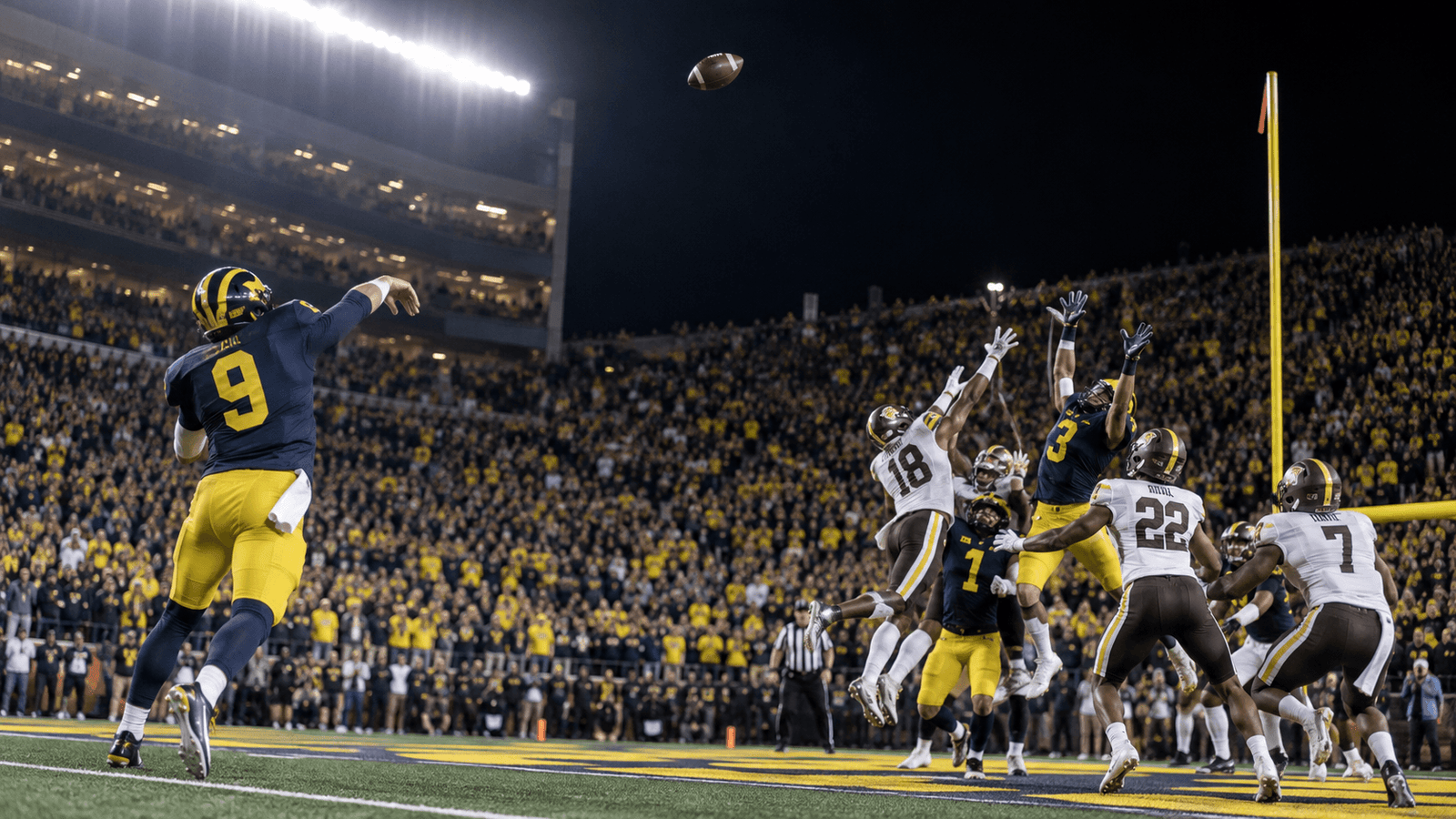
ANN ARBOR, Mich. — One second changed everything.
Michigan appeared to have lost.
Western Michigan believed it had pulled off one of the biggest upsets in program history.
Then the replay officials stepped in.
After a review determined that one second remained on the clock, Michigan received one final opportunity. Quarterback Bryce Underwood made that second chance count, connecting with J.J. Buchanan on a dramatic Hail Mary touchdown to give the No. 16 Wolverines a stunning 13-12 victory over Western Michigan at Michigan Stadium.
The finish immediately became one of the most debated moments of the 2026 college football season.
The Big Ten has since defended the replay decision, releasing an explanation along with video and audio from the review process. Western Michigan officials sought clarification, received it and ultimately said they would move forward, even as the controversial ending continued to generate intense debate among fans and analysts.

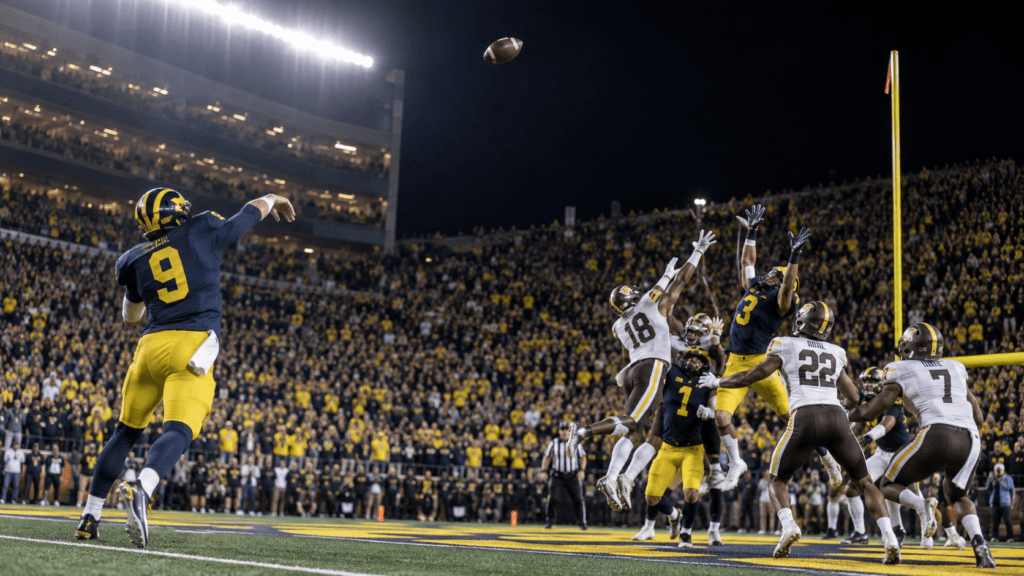
Table of Contents
Michigan vs. Western Michigan: How One Second Changed the Game
The final sequence was pure college football chaos.
Michigan had one last chance to avoid an embarrassing home loss. Underwood launched a deep pass toward the end zone, but the throw did not produce a touchdown. To many watching inside the stadium and on television, the game appeared to be over.
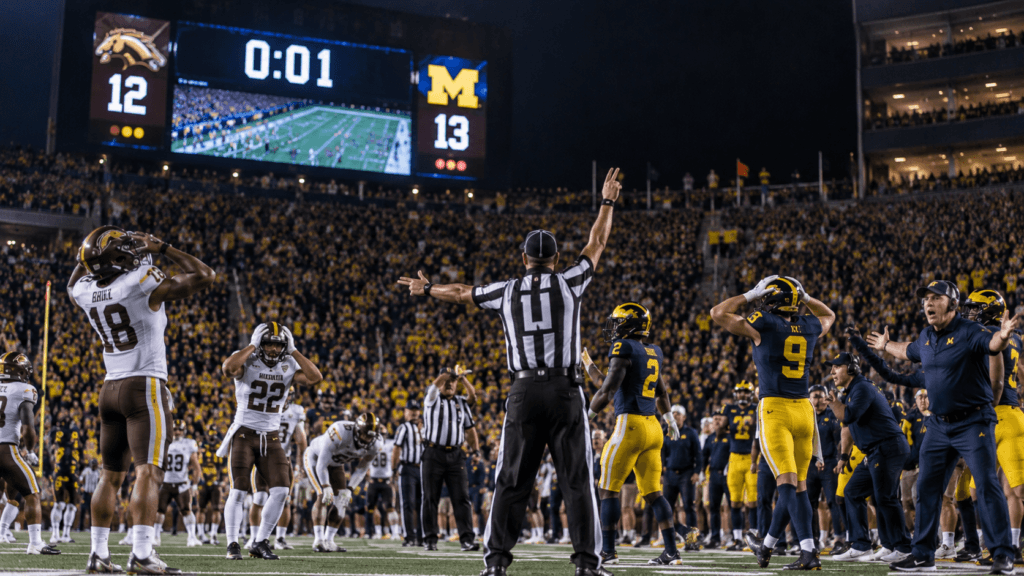
The clock appeared to reach zero.
Western Michigan players began celebrating what looked like a historic upset.
But officials initiated a review.
After examining the final play, replay officials determined that there had been one second remaining when Western Michigan defender Micah Davis made contact with the football.
That ruling gave Michigan another play.
And this time, the Wolverines did not miss.
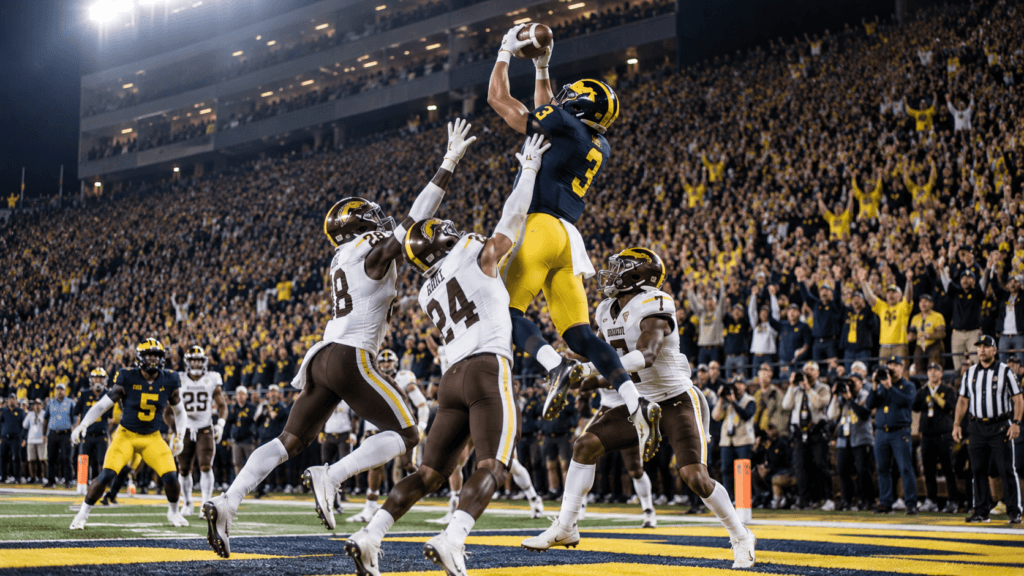
Underwood launched another deep pass, and Buchanan came down with the football in the end zone for the game-winning score.
Michigan had gone from apparent defeat to an improbable 13-12 victory in a matter of minutes.
Why Did Michigan Get Another Play?
That question is at the center of the Michigan vs. Western Michigan controversy.
The Big Ten said its replay officials determined that Western Michigan’s defender began his jump from an established out-of-bounds position and made contact with the ball while one second remained.
Because of the circumstances surrounding the ball touching a player who was out of bounds, officials determined the clock should stop with one second remaining.
The conference said it used a direct view of the Michigan Stadium game clock during the review process.
The Big Ten also explained that cameras used in the replay system, including the game-clock camera, are synchronized before the game.
According to the conference’s explanation, the replay evidence supported restoring the final second.
That explanation did not completely end the debate.
Many viewers pointed to the television broadcast, where the clock appeared to reach 0:00 during the original Hail Mary attempt. The apparent difference between what viewers saw on television and what replay officials reviewed became one of the biggest talking points after the game.
Big Ten Stands by the Replay Decision
The Big Ten did not quietly move past the controversy.
Instead, the conference publicly defended the ruling.
The league released video and audio associated with the replay review and explained that officials used a side-by-side view of the play and the stadium clock to reach the final decision.
The conference’s position was straightforward: one second remained.
That meant Michigan was legally entitled to another offensive play.
The decision was especially significant because the first Hail Mary had appeared to end the game. Without the restored second, Western Michigan would have walked out of Michigan Stadium with a monumental victory.
Instead, Michigan received one final snap.
And that snap changed the result.
The Big Ten’s explanation has provided the official reasoning behind the decision, although questions surrounding the difference between the broadcast clock and the replay system have continued to fuel discussion.
Western Michigan Chooses to Move Forward
For Western Michigan, the ending was devastating.
The Broncos entered the game as massive underdogs and came within seconds of defeating one of college football’s most recognizable programs.
A victory would have been historic.
Instead, Western Michigan watched a celebration turn into heartbreak.
Still, the program has not chosen to publicly wage a prolonged battle against the Big Ten.
Western Michigan officials contacted the Big Ten and requested clarification regarding the review. Mid-American Conference commissioner Jon Steinbrecher said the conference received an explanation along with video and audio supporting the decision.
Western Michigan head coach Lance Taylor emphasized that his team should not use officiating as an excuse.
His message was clear: the Broncos cannot allow frustration over the final sequence to define their season.
That approach may ultimately matter.
Western Michigan showed it could compete with a ranked opponent on the road and nearly produced one of the most memorable upsets of the opening weekend.
Lance Taylor’s Message: Don’t Get Bitter, Get Better
Taylor’s response to the controversy could become an important moment for his team.
The easiest reaction would have been anger.
There was certainly plenty of it online.
Fans questioned the timing, replay process and the decision to restore one second. Social media quickly turned the ending into one of the most discussed plays in college football.
But Taylor took a different approach.
His focus was on preventing his players from becoming consumed by something they could no longer change.
Western Michigan had already received clarification.
The final score would not be reversed.
The Broncos’ challenge now is to carry the positives from their performance into the rest of the season.
For a team that came within one second of defeating Michigan in Ann Arbor, there is plenty of evidence that the Broncos can remain competitive.
Sometimes a painful loss can reveal more about a football team than an easy victory.
Western Michigan now has to prove that Saturday’s performance was not simply a one-night surprise.
Bryce Underwood Gets a Second Chance
The ending was also a defining moment for Michigan quarterback Bryce Underwood.
Underwood initially believed the game was over.
Like many players and viewers, he saw the clock reach zero and assumed Michigan’s final opportunity had disappeared.
Then the officials announced that there would be another play.
For a young quarterback, that is an unusual kind of pressure.
A second Hail Mary is not simply another throw.
It comes with the knowledge that the entire game has been placed back in your hands.
Michigan had already been given an extraordinary opportunity. Failing to capitalize would have made the controversial review even more difficult for the Wolverines to escape.
Underwood delivered.
His final deep throw found Buchanan in the end zone, producing one of the most dramatic finishes Michigan Stadium has seen in years.
The play saved Michigan from an upset loss.
But it also ensured that the conversation after the game would be about far more than a touchdown.
J.J. Buchanan Becomes the Hero
Every Hail Mary needs a quarterback willing to throw the ball.
But it also needs someone willing—and able—to come down with it.
That player was J.J. Buchanan.
Buchanan’s catch turned an improbable opportunity into a Michigan victory.
For Western Michigan, the Broncos had successfully defended one Hail Mary attempt.
The second attempt proved impossible to stop.
The final touchdown created an emotional explosion inside Michigan Stadium.
Moments earlier, Michigan appeared to be staring at an upset that would have immediately become one of the most embarrassing losses in recent program history.
Instead, the Wolverines survived.
Buchanan’s catch will now live alongside the controversy that made it possible.
That is the strange nature of the play: it was both a spectacular football moment and the conclusion to one of the most disputed replay decisions of the season.
Michigan Escaped, But the Performance Raises Serious Questions
Michigan won.
That is the most important fact in the standings.
But the Wolverines cannot ignore what happened during the rest of the game.
Michigan entered the matchup heavily favored and expected to control Western Michigan.
Instead, the Wolverines spent much of the night struggling against an opponent that many expected them to defeat comfortably.
The Hail Mary prevented a disastrous loss, but it did not erase the problems Michigan displayed.
Coach Kyle Whittingham acknowledged after the game that the team needs significant improvement.
That assessment seems difficult to argue with.
Michigan may have escaped with a victory, but surviving Western Michigan on the final play is very different from dominating an opponent.
The Wolverines will face much tougher competition as the season progresses.
A miracle finish cannot become a weekly strategy.
Michigan’s offense must become more consistent. The team must reduce mistakes and avoid putting itself in situations where a single replay decision determines the outcome.
In college football, surviving is sometimes enough.
But surviving one week does not guarantee success the next.
Kyle Whittingham’s Michigan Debut Was Anything but Normal
A coaching debut is supposed to provide a first impression.
Kyle Whittingham’s first game at Michigan certainly did that.
Just not in the way anyone expected.
The Wolverines escaped with a win, but the game was filled with tension, uncertainty and controversy.
Whittingham avoided a season-opening defeat, yet Michigan’s performance created immediate concerns.
That combination makes the result complicated.
A win is a win.
But context matters.
Michigan was not expected to need a second-chance Hail Mary to defeat Western Michigan at home.
The fact that it did means Whittingham and his staff have plenty to evaluate.
The upcoming schedule will not provide much time to relax.
Michigan needs to quickly determine whether the problems against Western Michigan were opening-week issues—or signs of deeper concerns.
What the Michigan Win Means for the Wolverines
From a purely mathematical standpoint, Michigan is 1-0.
That matters.
The Wolverines avoided the type of early-season loss that could damage their national perception and potentially affect postseason positioning.
But the narrow victory will not be viewed the same way as a dominant performance.
Michigan’s ranking, confidence and reputation will now be tested by what happens next.
The biggest question is simple:
Can Michigan play substantially better?
The Wolverines cannot depend on dramatic finishes against stronger opponents.
The defense will need consistency.
The offense will need to create more reliable production.
And the coaching staff will need to make adjustments quickly.
Michigan survived the first weekend.
Now comes the harder part: proving the Wolverines are actually capable of becoming the team many expected before the season began.
What the Loss Means for Western Michigan
Western Michigan lost the game.
But the Broncos did not leave Ann Arbor without something valuable.
They left with evidence.
Evidence that they could compete.
Evidence that they could challenge a ranked Big Ten opponent.
And evidence that their season still has significant potential.
The Broncos were enormous underdogs, yet they nearly defeated Michigan in one of college football’s most difficult road environments.
That performance should create confidence.
Of course, confidence does not erase the pain.
Players believed they had won.
They began celebrating.
Then they were forced to defend another play.
That emotional swing is difficult for any team.
But Western Michigan’s response will now become part of its identity.
The Broncos can spend weeks discussing what happened.
Or they can use the experience as motivation.
Taylor has made it clear which direction he prefers.
The Bigger Problem: College Football’s Replay Transparency
The Michigan-Western Michigan finish raises a larger issue beyond one game.
How transparent should replay decisions be?
Modern college football relies heavily on technology.
Multiple cameras.
High-speed video.
Replay centers.
Time synchronization systems.
Yet viewers still need to trust that the process is working.
The controversy demonstrated what happens when fans see one thing while officials later explain that a different system showed another.
Even if the final ruling is correct, the perception problem remains.
Fans want to understand how a decision was reached.
The Big Ten’s decision to release video and audio was therefore significant.
It gave the public a closer look at the review process.
That does not mean everyone agrees with the ruling.
But transparency is important, especially in a sport where a single second can determine the winner.
College football has always had controversial calls.
Technology was supposed to reduce those moments.
Instead, technology has created a new challenge:
When multiple clocks, cameras and video feeds appear to show different things, which one should fans trust?
That question will likely continue long after Michigan’s 13-12 victory fades from the headlines.
Did the Big Ten Make the Right Call?
The official answer is yes.
The Big Ten reviewed the play and determined that one second remained.
The Mid-American Conference sought clarification and later accepted the explanation provided by the Big Ten.
From an official standpoint, the game result stands.
But the public debate is more complicated.
Many viewers remain focused on the television broadcast and the apparent expiration of the clock.
Others point to the replay evidence released by the conference.
This is why the play will continue to be discussed.
There are two separate questions:
- What did the officials rule?
- Do fans believe the replay process was clear and convincing?
The first question has been answered.
Michigan was awarded one second.
The second question is likely to remain controversial.
And honestly, that may be the lasting legacy of the game.
Michigan vs. Western Michigan Controversy: The Final Verdict
Michigan won the football game.
The Big Ten says the replay process was correct.
Western Michigan received an explanation and has chosen to move forward.
The result will not change.
But the controversy will remain one of the defining stories of the opening weekend of the 2026 college football season.
One second separated Western Michigan from a historic upset.
One second gave Michigan another opportunity.
And one catch transformed the entire night.
For Michigan, it was a miracle.
For Western Michigan, it was heartbreak.
For college football fans, it was another reminder that the game is never over until the officials say it is.
And in Ann Arbor, on a September night that was supposed to be a routine victory, one final second became the most important second of the season.
Michigan vs. Western Michigan: Key Takeaways
- Michigan defeated Western Michigan 13-12.
- Bryce Underwood threw the game-winning Hail Mary to J.J. Buchanan.
- Michigan received another play after replay officials restored one second to the clock.
- The Big Ten publicly defended the decision and released replay video and audio.
- Western Michigan and the MAC requested clarification and received an explanation from the conference.
- The ending created major debate because the television broadcast appeared to show the clock reaching 0:00.
- Michigan escaped a major upset but faces serious questions about its overall performance.
- Western Michigan showed it can compete with high-level competition.
Frequently Asked Questions
Why did Michigan get one more second?
The Big Ten said replay officials determined that Western Michigan defender Micah Davis made contact with the ball while one second remained on the stadium game clock. Because of the circumstances surrounding the contact and the player being out of bounds, officials ruled that one second should remain.
Who caught Michigan’s game-winning Hail Mary?
J.J. Buchanan caught Bryce Underwood’s game-winning Hail Mary touchdown.
What was the final score?
Michigan defeated Western Michigan 13-12.
Did the Big Ten admit the call was controversial?
The Big Ten defended the ruling and released video and audio from the replay process to explain why officials restored one second.
Did Western Michigan protest the result?
Western Michigan officials and the Mid-American Conference requested clarification from the Big Ten. After receiving the explanation and replay material, the program indicated it would move forward.
Why are fans still debating the Michigan vs. Western Michigan finish?
Much of the debate centers on the apparent difference between the clock displayed during the television broadcast and the stadium-clock footage used during the official replay review.
What is next for Michigan?
Michigan faces a major test in its next game and will need to improve significantly after narrowly escaping Western Michigan.
Football
UEFA Nations League Matchday 4 Highlights: Portugal Reach Quarter-Finals as Højlund Decisive for Denmark
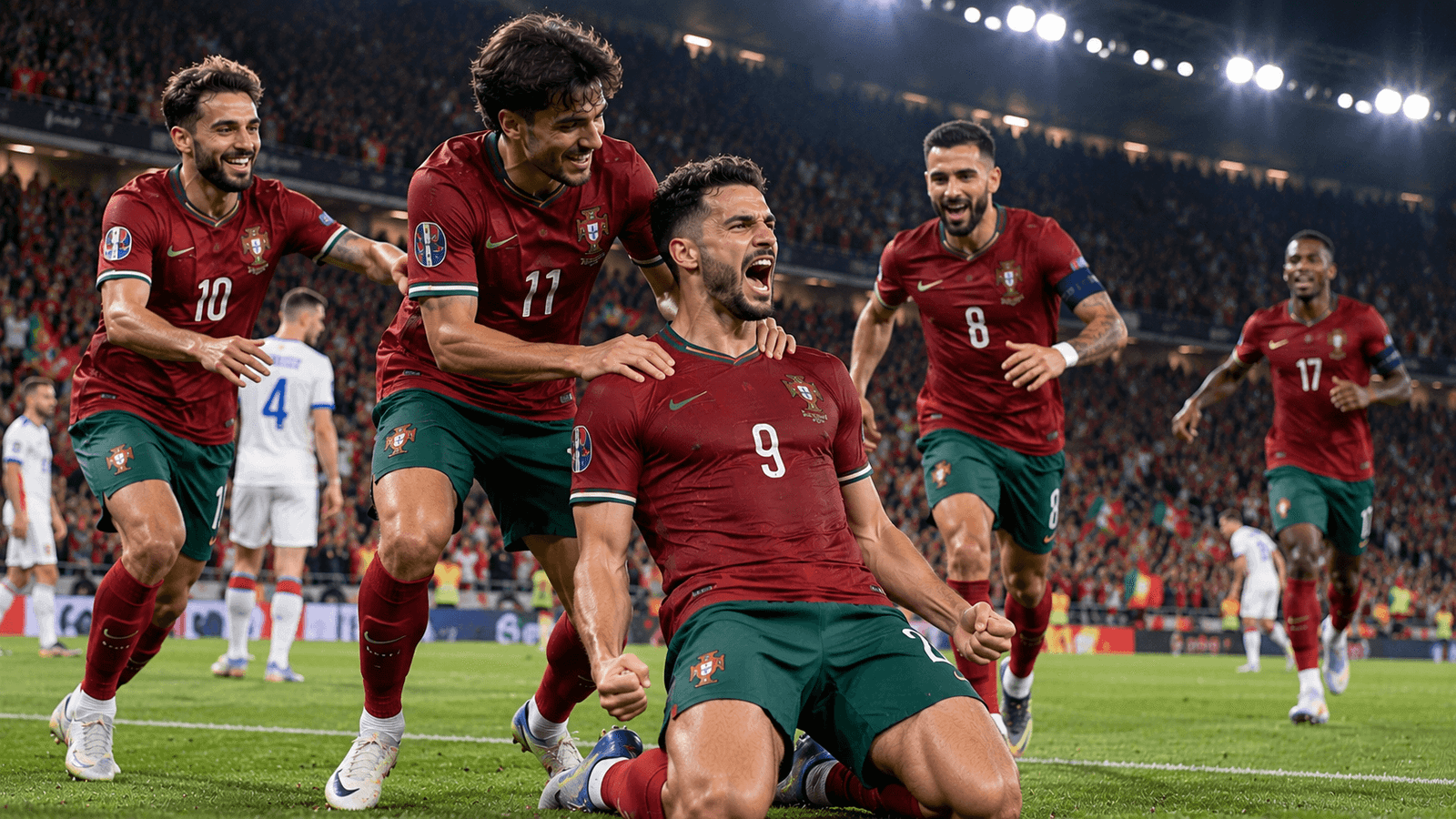
UEFA Nations League Matchday 4 highlights: Portugal beat Norway 2-1 to reach the quarter-finals, while Højlund scored for Denmark against Wales.while Rasmus Højlund scored the decisive penalty as Denmark defeated Wales 1-0.
The fourth matchday of the 2026/27 UEFA Nations League produced several important results across League A and the lower divisions. Portugal maintained their perfect start in Group A4, while Denmark strengthened their position with a narrow victory in Wales. The Netherlands also moved into a strong position in Group A2 after beating Serbia 2-1.
Elsewhere, Germany were held to a goalless draw by Greece, Austria drew with Kosovo, Ireland and Israel shared the points, and Azerbaijan moved to the top of Group D2.
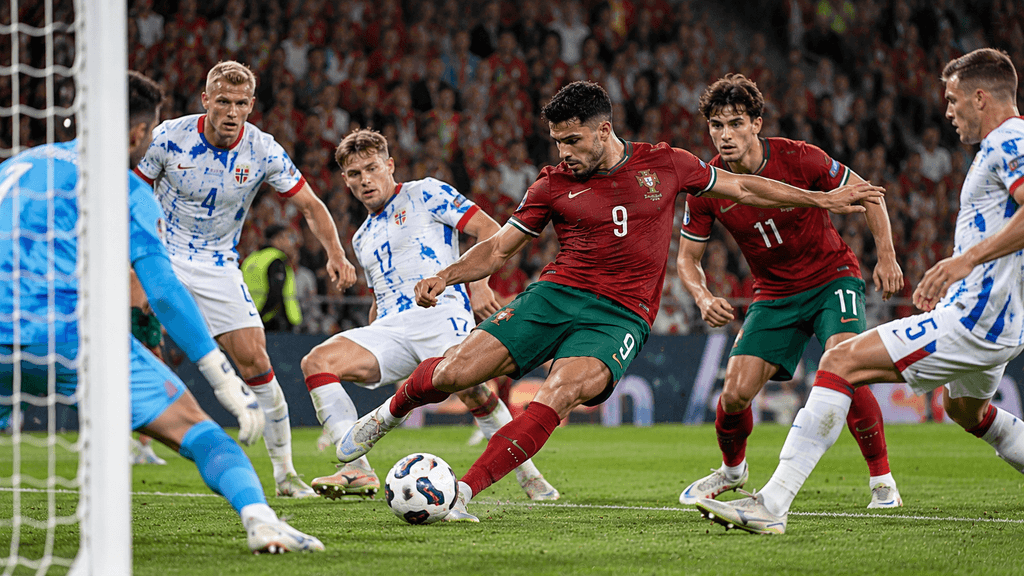
Portugal 2-1 Norway: Ramos sends Portugal into the quarter-finals
Portugal completed a perfect four wins from four matches by coming from behind to defeat Norway 2-1 at home.
The result confirmed Portugal’s place in the Nations League quarter-finals and kept their 100% record intact. UEFA lists Portugal at the top of Group A4 with 12 points from four matches, six points clear of Denmark.
Norway produced the first major moment of the match in the 36th minute.
Kristoffer Ajer put the visitors ahead with a spectacular finish from the edge of the penalty area. The Norwegian defender connected with the ball using the outside of his right foot and sent it toward the far corner, giving Portugal goalkeeper Diogo Costa little chance.
Portugal’s response was immediate.
Just two minutes later, João Cancelo brought the hosts level with an outstanding strike of his own. A long throw eventually fell to the Portugal right-back outside the penalty area, and Cancelo’s powerful volley found the top-right corner.
The teams went into halftime level at 1-1.
Portugal continued to control large portions of possession after the break, forcing Norway to defend deeper. Norway still looked dangerous on the counterattack, with Erling Haaland involved in the visitors’ attacking moves.
Haaland was eventually substituted in the 68th minute, with Jørgen Strand Larsen replacing him. The supplied live match report described the Manchester City striker as looking tired as he left the field.
Portugal eventually found the breakthrough in the 79th minute.
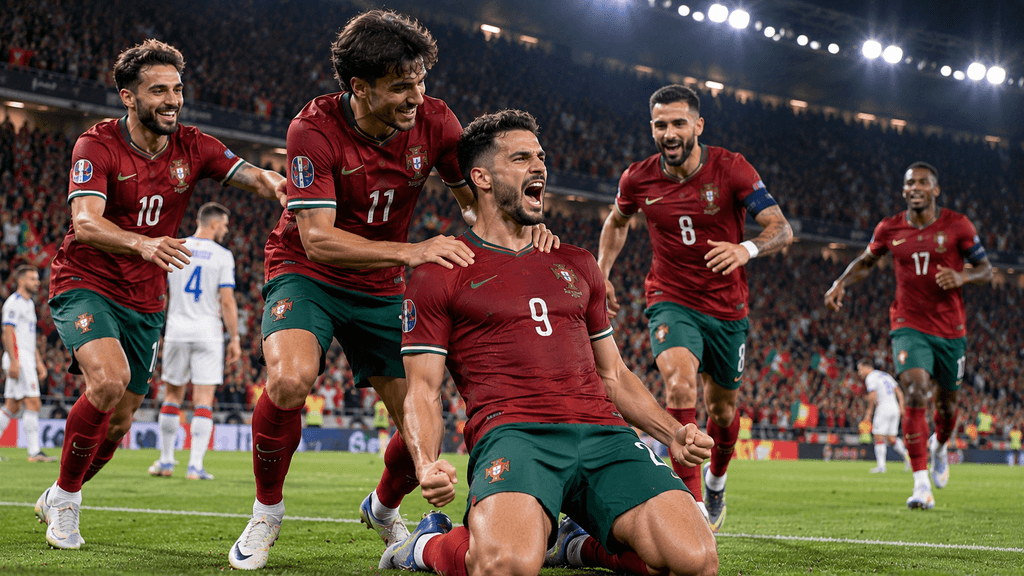
João Félix received the ball near the far post and spotted Gonçalo Ramos making a run. Félix’s clever lay-off allowed Ramos to finish from close range and complete Portugal’s comeback.
Ramos’ goal proved decisive as Portugal protected their 2-1 advantage through the closing stages.
The match ended with additional drama when Francisco Conceição was sent off after receiving two yellow cards in quick succession.
Portugal’s victory means they are guaranteed a place in the quarter-finals, while Norway remain in fourth place in Group A4 and will need results from their remaining matches to improve their position.
Portugal’s Group A4 position
| Team | Played | Points |
|---|---|---|
| Portugal | 4 | 12 |
| Denmark | 4 | 6 |
| Wales | 4 | 3 |
| Norway | 4 | 3 |
Portugal have won all four of their group matches and have scored nine goals while conceding four.
Wales 0-1 Denmark: Højlund delivers from the penalty spot
Denmark claimed a crucial 1-0 victory over Wales in Cardiff, with Rasmus Højlund once again proving decisive.
Wales started positively and enjoyed periods of possession early in the match. Brennan Johnson and Lewis Koumas provided attacking threats as the hosts attempted to put Denmark under pressure.
Denmark gradually grew into the contest.
Gustav Isaksen and Oliver Provstgaard both went close before halftime, while Wales goalkeeper Danny Ward produced two important saves in quick succession to deny Højlund and Isaksen.
The decisive moment came when a misplaced pass from Ward resulted in a penalty.
Højlund stepped up and calmly converted the spot kick.
The goal was particularly significant for the Manchester United striker. UEFA notes that it was Højlund’s third goal in his last four Nations League appearances.
The 1-0 victory gave Denmark their second win of the campaign and extended their unbeaten run against Wales to five matches.
Denmark now sit second in Group A4 on six points, although Portugal have already created a substantial lead at the top.
Netherlands 2-1 Serbia: Zirkzee makes the difference
The Netherlands continued their unbeaten start under Xavi Hernández with a 2-1 victory over Serbia in Eindhoven.
The Dutch dominated the opening stages and eventually took the lead when Teun Koopmeiners’ free-kick travelled through a crowded penalty area and found the net.
Serbia responded before halftime.
Mihajlo Cvetković scored with a header, ensuring the Netherlands had both scored and conceded in every match of their Nations League campaign.
The Netherlands continued searching for a winner, and Joshua Zirkzee eventually provided it.
The forward scored from close range with 19 minutes remaining to give the Oranje their second win of the group stage.
The victory leaves the Netherlands unbeaten after four matches, with two wins and two draws.
Greece 0-0 Germany: Hosts frustrate Klopp’s side
Germany were held to a 0-0 draw by Greece in Thessaloniki.
The result was particularly notable because Greece had beaten Germany for the first time in their previous meeting.
Greece nearly opened the scoring when Giorgos Masouras’ header was saved by Jonas Urbig.
Germany responded with sustained pressure during the first half. The visitors produced 15 attempts before halftime and forced Greece goalkeeper Kostas Tzolakis into several interventions, including a strong save from David Raum.
The second half was much quieter.
Germany continued to search for a breakthrough but could not find one, while Philipp Treu came closest late on when his half-volley went over the crossbar.
The draw allowed Greece to remain unbeaten in the section.
Kosovo 1-1 Austria: UEFA Nations League Matchday 4 highlights
Austria maintained their position at the top of Group B3 after drawing 1-1 away to Kosovo.
Kosovo took the lead through substitute Fisnik Asllani in the 70th minute.
Austria responded late through another substitute, with Christoph Lang heading in the equalizer.
The point kept Austria at the summit of Group B3.
Ireland 1-1 Israel: UEFA Nations League Matchday 4 highlights
The Republic of Ireland and Israel finished 1-1 in a match played behind closed doors on neutral ground.
Ireland took the lead through Troy Parrott, who continued his impressive scoring run.
Parrott’s goal was his fourth in three Nations League matches, with all four goals coming during the first half.
Israel eventually found an equalizer to secure a point.
Azerbaijan 1-0 Lithuania: UEFA Nations League Matchday 4 highlights
Azerbaijan moved to the top of Group D2 after beating Lithuania 1-0.
Sabah forward Abdulakh Khaibulaev scored his first international goal to settle the contest.
The victory also means Azerbaijan remain the only unbeaten team in the group.
Malta 1-0 Andorra: UEFA Nations League Matchday 4 highlights
Malta continued their strong campaign in Group D1 with a 1-0 victory over Andorra.
The result moved Malta five points clear at the top of the section, according to UEFA’s Matchday 4 roundup.
What the Matchday 4 results mean
Portugal’s victory was the biggest result of the day.
The reigning Nations League champions have won all four of their matches and have now secured their passage into the quarter-finals. Reuters also reported that Portugal’s win maintained their perfect Group A4 record and moved them six points ahead of Denmark.
For Norway, the situation is considerably more difficult.
The team remain on three points after four matches and will need strong results in their remaining fixtures to improve their chances of advancing.
Denmark’s victory keeps them firmly in the race for second place, while Wales also remain mathematically involved despite their defeat.
The Netherlands’ victory was equally important in Group A2, where the Dutch remain unbeaten and strengthened their position after Greece and Germany played out a goalless draw.
Matchday 4 results: UEFA Nations League Matchday 4 highlights
The completed Sunday fixtures were:
- Greece 0-0 Germany
- Netherlands 2-1 Serbia
- Portugal 2-1 Norway
- Wales 0-1 Denmark
- Kosovo 1-1 Austria
- Republic of Ireland 1-1 Israel
- Malta 1-0 Andorra
- Azerbaijan 1-0 Lithuania
UEFA’s official results list confirms the Matchday 4 scorelines.
Matchday 4 continues Monday and Tuesday
The fourth matchday is not finished yet.
Monday’s schedule includes France vs Belgium, Italy vs Türkiye, Northern Ireland vs Georgia, Ukraine vs Hungary, Bosnia and Herzegovina vs Poland, Romania vs Sweden, Cyprus vs Latvia and Montenegro vs Armenia.
Tuesday features several major League A fixtures, including Croatia vs Spain and England vs Czechia.
The results could significantly reshape the qualification picture before the Nations League league phase resumes for its final matches in November.
The bigger picture
Sunday’s action showed how quickly the Nations League table can change.
Portugal have already achieved the main objective by securing a quarter-final place, but the battle behind them remains open. Denmark have given themselves an important boost, while Norway now face a much tougher path after another defeat.
Højlund’s penalty also underlined Denmark’s reliance on their attacking forward. With three goals in his last four Nations League appearances, the striker has become one of the key figures in Denmark’s campaign.
For the Netherlands, Zirkzee’s late contribution kept their unbeaten run alive, while Germany’s inability to beat Greece means the pressure will remain on Jürgen Klopp’s side.
With the final two matchdays still to come in November, the race for qualification, promotion and survival remains wide open across the UEFA Nations League.
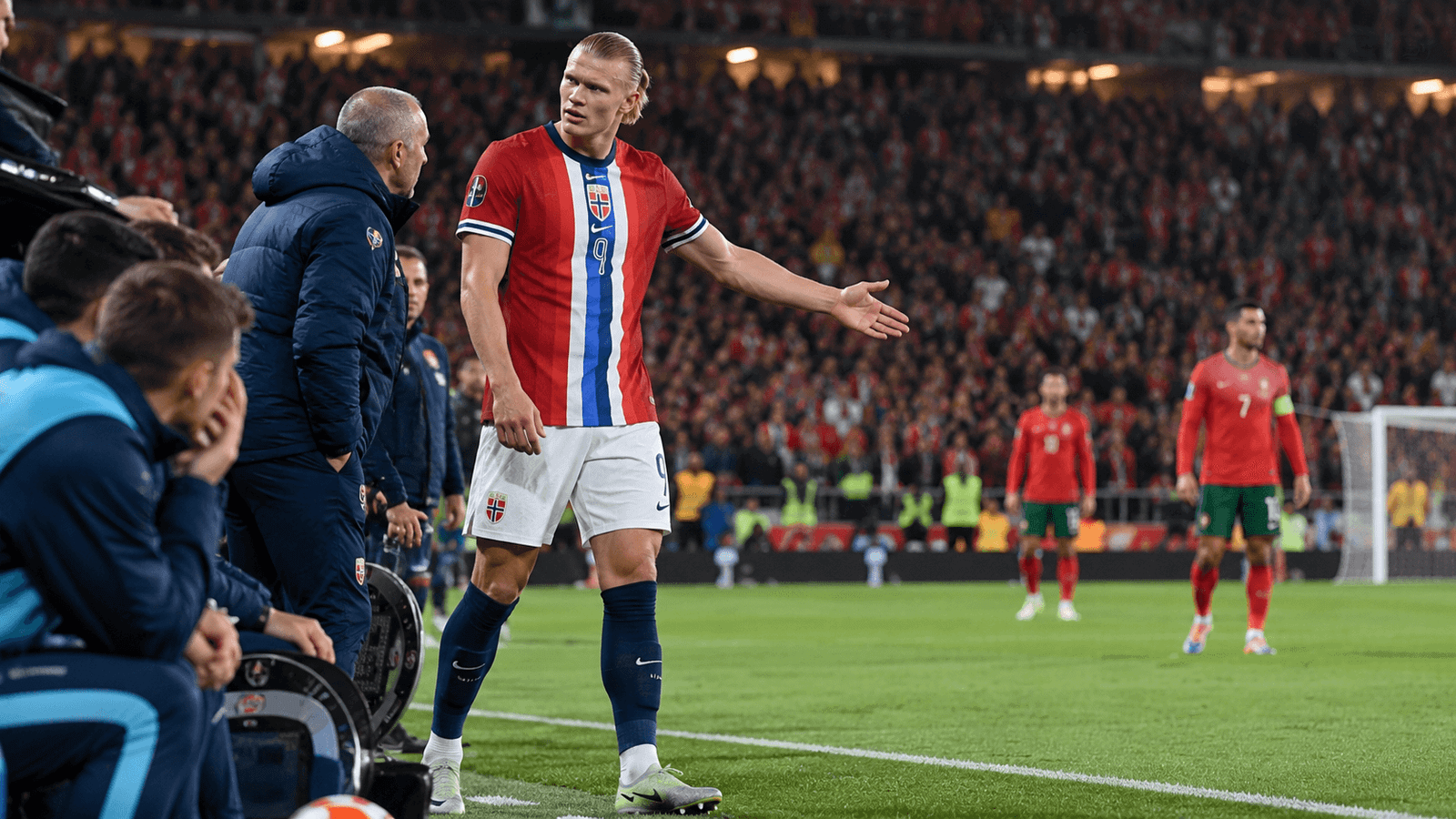
Erling Haaland Injury has become a talking point for Manchester City after the Norway striker asked to be substituted during Sunday’s 2-1 UEFA Nations League defeat to Portugal.
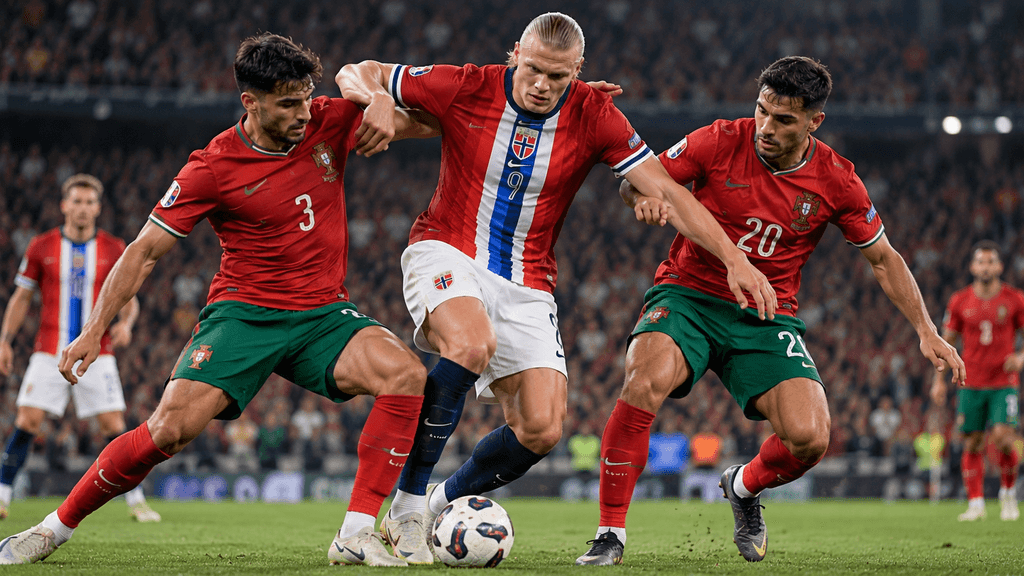
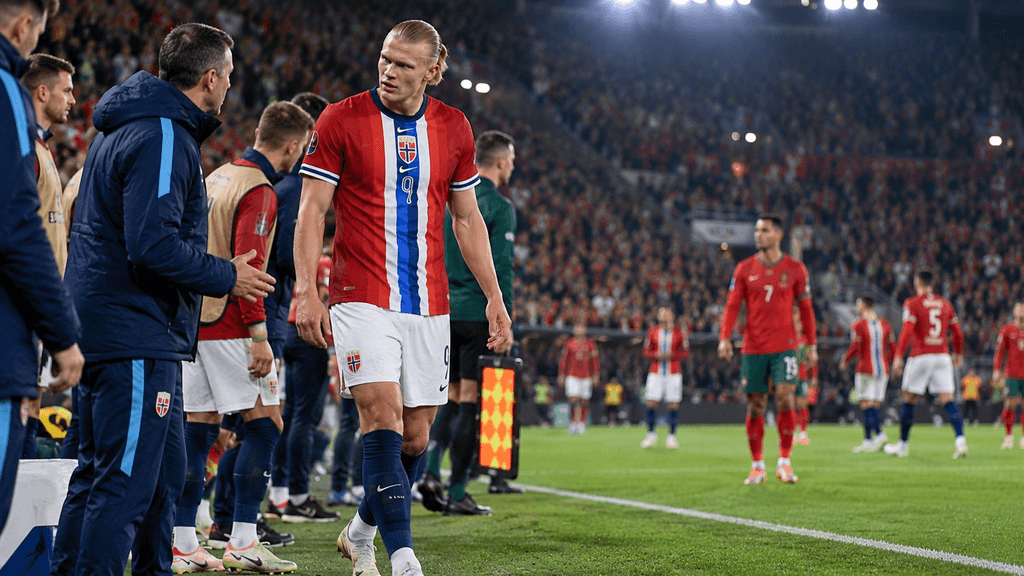
The Manchester City forward was replaced by Jørgen Strand Larsen in the 67th minute at the Estádio do Dragão after appearing to signal toward the Norway bench and subsequently limping from the field.
The incident immediately raised concerns because Haaland’s next club assignment is a major Premier League meeting with Liverpool at Anfield.
However, there is an important distinction between an injury scare and a confirmed injury: no official diagnosis or confirmed injury timeline had been announced immediately after the Portugal match. Norway coach Ståle Solbakken also suggested that workload and fatigue were significant factors in the decision to manage Haaland’s minutes.
Table of Contents
What Happened to Erling Haaland Against Portugal?
Haaland started Norway’s Nations League match against Portugal but did not finish the game.
The striker was substituted in the 67th minute, with Strand Larsen coming on as Norway attempted to remain competitive against the defending Nations League champions.
Official Norwegian match records confirm the substitution took place at 67 minutes.
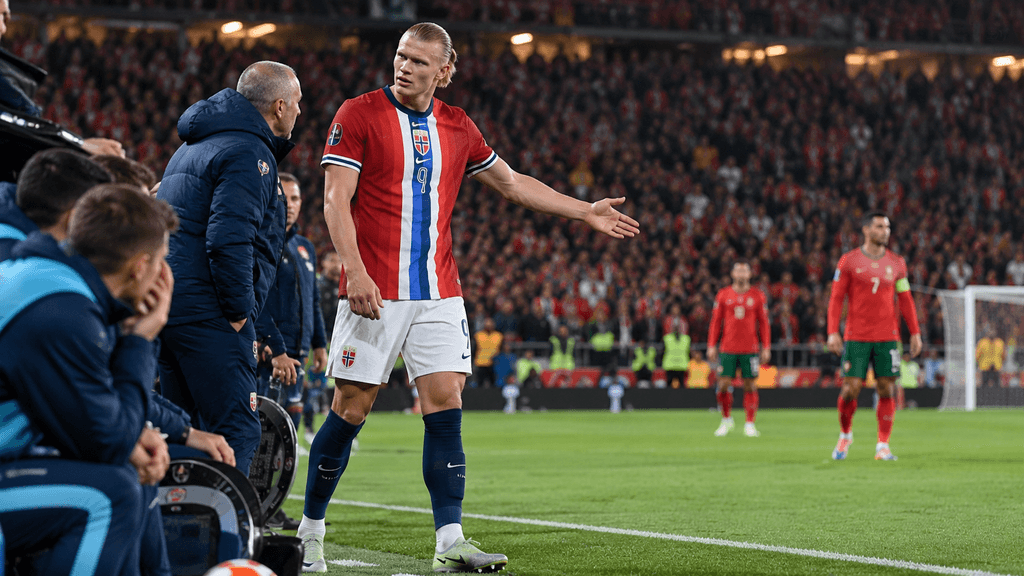
The concern intensified because Haaland appeared to communicate with the bench before coming off and was seen limping as he left the field.
At that point, the match was still tied 1-1.
Norway had taken the lead through Kristoffer Ajer in the 36th minute, but Portugal responded almost immediately when João Cancelo equalized two minutes later.
Haaland’s night ended before Portugal eventually found the winning goal.
Gonçalo Ramos scored in the 79th minute, giving Portugal a 2-1 victory and completing another win over Norway.
Is Erling Haaland Actually Injured?
That is still the biggest unanswered question.
As of the latest available reporting, there has been no confirmed diagnosis establishing the nature or severity of a Haaland injury.
That means reports describing the incident as a major injury should be treated cautiously.
What is confirmed is that Haaland asked to come off and appeared uncomfortable as he left the pitch.
What remains unclear is whether he suffered a specific physical problem or whether the substitution was primarily precautionary because of fatigue and workload.
Norway manager Ståle Solbakken provided some important context after the match.
He explained that he had a conversation with Haaland before the game about his workload and said the striker had already played a heavy schedule.
Solbakken indicated that Norway had discussed the possibility of limiting Haaland’s minutes and that the striker’s physical condition was a consideration.
That makes the situation less straightforward than a typical injury substitution.
What Did Ståle Solbakken Say About Haaland?
Solbakken’s comments are particularly important because they provide the clearest explanation available from the Norway camp.
The coach said he had a “heart-to-heart conversation” with Haaland before the Portugal match concerning the striker’s workload.
According to Solbakken, Haaland had already played three consecutive full matches in the previous 10 days.
The Norway coach said they discussed different options, including the possibility that Haaland could play only part of the Portugal game.
Solbakken also indicated that Haaland had been feeling the physical effects of his recent workload.
That context helps explain why the Norway staff were prepared to take the striker off before the final stages of the match.
The fact that Haaland himself signaled for the substitution, however, naturally created concern.
For now, the safest conclusion is that Haaland experienced enough discomfort or fatigue to request an early exit, but a serious injury has not been confirmed.
Haaland’s Substitution Came at a Crucial Moment
The timing made the incident even more noticeable.
Haaland left with the score tied 1-1 and just over 20 minutes remaining.
Norway had already demonstrated that it could hurt Portugal.
Ajer had put the visitors ahead with an outstanding finish in the 36th minute.
Portugal answered almost instantly through Cancelo.
The match remained level at halftime and into the second half.
Haaland had a chance of his own shortly after the hour mark, but his effort went across the face of goal rather than finding the net. AFP reported that he was replaced a few minutes later.
After Haaland departed, Portugal eventually broke the deadlock.
Ramos scored in the 79th minute after being set up by João Félix.
Portugal then survived the closing stages despite finishing with 10 men following Francisco Conceição’s dismissal.
The 2-1 result secured Portugal’s place in the Nations League quarterfinals.
Why Manchester City Will Be Watching Closely
The timing of Haaland’s substitution is particularly significant for Manchester City.
The club is scheduled to return to Premier League action against Liverpool at Anfield.
That means City could potentially face a major selection question if Haaland is not fully fit.
Haaland has been one of the most important attacking players in European football and remains central to City’s offensive plans.
A confirmed absence would obviously change the team’s attacking options.
But it is too early to conclude that he will miss the Liverpool game.
The available evidence currently points to a player who was struggling enough to leave the match, combined with a Norway coaching staff already conscious of his workload.
The next step is a proper medical assessment.
Until that happens, predictions about a specific return date would be premature.
Haaland Had Already Been Carrying a Heavy Workload
One of the most revealing details from Solbakken was the reference to Haaland’s recent workload.
The striker had played three straight 90-minute matches before facing Portugal.
That is significant for any player.
For a striker who relies heavily on explosive acceleration, physical duels and repeated high-intensity movements, fatigue can become a serious performance and injury-management issue.
International windows can also create unusual scheduling pressures.
Players leave their clubs, travel internationally, train with a different coaching staff and then return to domestic competition.
For elite players involved in club and international football, workload management has become an increasingly important part of modern football.
Solbakken’s comments suggest Norway was already aware of that issue before Haaland’s substitution.
How Many Goals Has Haaland Scored for Norway?
Haaland has become Norway’s leading attacking figure and has an extraordinary international scoring record.
He entered the Portugal match with 65 goals in 58 appearances for Norway, according to the supplied reporting.
He did not add to that total against Portugal.
His inability to score was also unusual given his recent form.
The striker has been among the leading scorers for Manchester City this season, with reports putting his total at seven goals across his appearances before the Portugal match.
That makes his fitness especially important to City.
Portugal Completes Another Win Over Norway
The Haaland concern overshadowed a significant result for Portugal.
Portugal defeated Norway 2-1, repeating the scoreline from their earlier meeting.
Norway had actually started the game strongly.
Ajer’s spectacular goal gave the visitors the lead after 36 minutes.
But Portugal’s response was immediate.
Cancelo equalized just two minutes later, sending the teams into halftime level.
Portugal then found the decisive goal through Ramos in the 79th minute.
The victory maintained Portugal’s perfect record in Group A4 and guaranteed the defending champions a place in the Nations League quarterfinals.
Haaland’s Exit Was Not the Only Major Story
Portugal’s victory also came without Cristiano Ronaldo.
Ronaldo had left the national-team camp before the previous match after learning he would not start, adding another layer of drama to Portugal’s international window.
Ramos, who started in Ronaldo’s place, ultimately scored the winner against Norway.
That made the match significant for Portugal on several levels.
But from a Manchester City perspective, Haaland’s substitution was arguably the most important development.
The result itself will matter to Norway’s Nations League campaign.
Haaland’s fitness could matter much more to City over the next few weeks.
What Does This Mean for Haaland’s Next Game?
At this stage, there are three important facts to keep in mind.
First, Haaland did leave the match early.
He was substituted in the 67th minute after signaling toward the bench, and he appeared to be limping as he departed.
Second, Norway has not publicly confirmed a serious injury.
The available comments from Solbakken instead emphasize fatigue and workload management.
Third, Manchester City still needs its own medical assessment before Haaland’s availability can be determined.
Therefore, it would be misleading to declare that Haaland is definitely injured or definitely ruled out of the Liverpool match.
The correct description at this point is an injury concern requiring assessment.
Why the Liverpool Match Matters
Manchester City’s next Premier League fixture is against Liverpool at Anfield.
That makes Haaland’s situation particularly important.
Liverpool away is one of the most demanding fixtures on the Premier League calendar, and City’s attacking approach could be significantly affected if its leading striker is unavailable.
But there is also a reason for caution.
If Haaland’s issue is primarily fatigue rather than a significant physical injury, the early substitution could actually have been part of a broader workload-management strategy.
The Norway camp had already discussed limiting his playing time.
That means the decision to remove him may ultimately prove precautionary rather than a sign of a long-term problem.
Only further medical information will establish that.
Norway Will Not Want to Take Unnecessary Risks
From Norway’s perspective, there was little reason to keep an uncomfortable Haaland on the pitch.
The match was still competitive, but the Nations League campaign extends beyond one night.
Norway’s next scheduled Nations League fixtures are against Wales on November 14 and Denmark on November 17, according to the Norwegian Football Federation’s current schedule.
Protecting the team’s biggest attacking asset is therefore understandable.
For Haaland himself, the priority is also clear.
A short-term precautionary substitution is far preferable to turning fatigue or a minor problem into a longer absence.
The Bigger Issue: Haaland’s Workload
The incident also highlights a wider issue affecting elite football.
Haaland’s schedule does not consist only of Premier League matches.
He also plays Champions League football, domestic cup competitions and international matches for Norway.
That workload creates constant pressure on players and medical teams.
For a striker with Haaland’s physical profile, maintaining availability can be just as important as maximizing minutes in every individual match.
Solbakken’s comments suggest Norway understood that before the Portugal game.
The coach had already discussed the situation directly with Haaland.
The eventual substitution may therefore have been the result of a combination of fatigue, discomfort and careful workload management.
What We Know About the Haaland Injury Scare
Here’s the current picture:
- Opponent: Portugal
- Competition: UEFA Nations League
- Result: Portugal 2-1 Norway
- Haaland started: Yes
- Haaland substituted: 67th minute
- Replacement: Jørgen Strand Larsen
- Reason: Haaland appeared to signal that he wanted to come off; exact injury status remains unclear
- Confirmed serious injury: No
- Norway coach’s explanation: Workload and fatigue were major considerations
- Next major club concern: Manchester City’s trip to Liverpool
- Haaland goals for Norway: 65 in 58 appearances before this match, according to the latest reporting
Official Norwegian match records confirm the timing of the substitution and the identity of the replacement.
Haaland Injury Update: What Happens Next?
The immediate priority will be assessment.
Manchester City’s medical team will need to establish whether Haaland suffered a specific injury, experienced muscular discomfort or simply reached the point where continuing was unnecessary.
That information will determine whether he can train normally and prepare for City’s next fixture.
Until an official update is released, fans should be cautious about social-media claims describing the problem as a major injury.
The visual of Haaland limping off was enough to cause concern, but the available evidence does not yet establish a serious diagnosis.
Final Verdict: Injury Scare, Not Yet a Confirmed Major Injury
Erling Haaland’s early departure from Norway’s 2-1 defeat to Portugal was undoubtedly concerning.
The Manchester City striker signaled toward the bench, came off in the 67th minute and appeared to limp as he left the pitch.
But there is currently a crucial difference between what happened on the field and what has been medically confirmed.
Haaland has not been publicly confirmed to have suffered a serious injury.
Norway coach Ståle Solbakken’s comments point toward fatigue and workload management as significant factors, while the exact physical issue, if any, remains unclear.
That leaves Manchester City waiting for further assessment before the club can know whether its star striker will be available for the Liverpool clash.
For now, the story is best described as an Erling Haaland injury scare rather than a confirmed long-term injury.
And after a demanding international schedule, that distinction could prove extremely important for both Haaland and Manchester City.
Frequently Asked Questions
What happened to Erling Haaland against Portugal?
Haaland started Norway’s Nations League match against Portugal but asked to be substituted in the 67th minute. He was replaced by Jørgen Strand Larsen and appeared to be uncomfortable as he left the field.
Is Erling Haaland injured?
The exact nature and severity of any injury have not been confirmed. Norway coach Ståle Solbakken indicated that workload and fatigue were important considerations surrounding Haaland’s minutes.
Why was Haaland substituted against Portugal?
Haaland appeared to signal to the Norway bench that he wanted to come off. Solbakken had already discussed managing his workload after a demanding run of matches.
Who replaced Erling Haaland?
Jørgen Strand Larsen replaced Haaland in the 67th minute.
Will Haaland play against Liverpool?
His availability cannot be confirmed until Manchester City’s medical assessment is completed. At the time of the latest reports, there was no confirmed diagnosis ruling him out.
What was the Portugal vs Norway score?
Portugal defeated Norway 2-1. Kristoffer Ajer scored for Norway, while João Cancelo and Gonçalo Ramos scored for Portugal.
How many goals has Haaland scored for Norway?
Haaland had scored 65 goals in 58 appearances for Norway before the Portugal match, according to the latest reporting supplied for the story.
When did Haaland leave the Portugal game?
Haaland was substituted in the 67th minute and replaced by Jørgen Strand Larsen.


Pathum Nissanka In the Asia Cup 2025 clash between Sri Lanka and Hong Kong at Dubai, CricDiary And Others all eyes were on Nissanka’s Match-Winning Knock, the stylish Sri Lankan opener who has grown into one of the most reliable T20 batters in world cricket. As Sri Lanka chased down 150 runs, Nissanka once again showcased why he is considered the heartbeat of Sri Lanka’s batting lineup, anchoring the innings with a spectacular 68 off 44 balls at a strike rate of 154.54.


But this knock was not just about numbers — it was a continuation of a journey that began years ago, marked by dedication, technique, and an unrelenting hunger to succeed at the highest level. This article takes a comprehensive look at Nissanka’s performance against Hong Kong, his fielding contribution, past academic and cricketing records, and his evolving role as Sri Lanka’s batting lynchpin.
Pathum Nissanka’s Current Match Performance – Asia Cup 2025 vs Hong Kong
Nissanka’s innings was the defining performance of the match. His 68 runs from 44 balls gave Sri Lanka the perfect launchpad in pursuit of 150. What stood out was his ability to control the tempo of the innings, rotating strike when boundaries weren’t available, and punishing loose deliveries with his trademark elegance.
Batting Breakdown
- Runs Scored: 68
- Balls Faced: 44
- Fours: 6
- Sixes: 2
- Strike Rate: 154.54
Match Impact
- He brought up his 16th T20I fifty in just 35 balls.
- Shared a 50-run partnership in just 28 balls with Kusal Perera, stabilizing Sri Lanka after early wickets.
- Survived three dropped chances, but capitalized brilliantly by accelerating towards the death overs.
- His knock contributed nearly 45% of Sri Lanka’s total runs at the point of his dismissal.
Fielding Efforts
Though not involved in catches during this match, Nissanka’s agility in the deep saved crucial runs. His anticipation and ground coverage are often underrated, but they make him a versatile contributor in the field.
Pathum Nissanka’s Match-Winning Knock (Match vs Hong Kong)
| Aspect | Statistic |
|---|---|
| Runs Scored | 68 |
| Balls Faced | 44 |
| Boundaries (4s) | 6 |
| Boundaries (6s) | 2 |
| Strike Rate | 154.54 |
| Milestone | 16th T20I Fifty |
| Partnership Impact | 50 off 28 balls |
| Fielding Effort | Saved 10+ runs in outfield |
Past Career Records
Pathum Nissanka’s rise in world cricket has been steady, built on consistency and technique.
Early T20I Records
- Debut: March 2021 vs West Indies
- First T20I Fifty: On debut, scoring 61 (known for his calm temperament).
- Since then, he has cemented his spot as Sri Lanka’s most dependable top-order batter.
T20I Career Stats (as of Asia Cup 2025)
- Matches: 70+
- Runs: 1900+
- Average: 33.00+
- Strike Rate: 130+
- Fifties: 16
- Hundreds: 1
ODI & Test Credentials
Though known as a T20 star now, Nissanka has also been an integral part of Sri Lanka’s ODI and Test setups:
- ODIs: Over 2000 runs with a batting average around 40.
- Tests: 5 centuries, showing his adaptability across formats.
This versatility makes him a rare modern batter who can switch gears depending on the format.
Academic and Cricketing Background
Born in Galle, Sri Lanka (1998), Nissanka’s journey is as inspiring as his batting.
- Education: He studied at Isipathana College, Colombo, where his cricketing journey began to flourish. His early coaches noticed his ability to play long innings under pressure.
- Domestic Cricket: Before his international debut, Nissanka dominated Sri Lanka’s domestic circuit, including a double century in first-class cricket, which marked him as a future star.
- International Breakthrough: Selected for Sri Lanka A tours, he impressed with his temperament, eventually earning a national call-up in 2021.
Academically, Nissanka has been known to value discipline and balance — often juggling his studies with cricket during his teenage years. This mental sharpness has translated into his ability to handle pressure situations on the field.
CricDiary Technical Analysis of His Batting
Pathum Nissanka’s batting style is a combination of classical technique and modern improvisation:
- Strong Front-Foot Play – He drives through the covers with elegance, often scoring boundaries along the ground.
- Use of the Crease – Comfortable against both pace and spin, he shifts deep in the crease to cut or pull.
- Rotation of Strike – Rarely bogged down; his singles-to-boundary ratio ensures the scoreboard keeps ticking.
- Six-Hitting Ability – While not a brute hitter, he uses timing and placement to clear the ropes.
Against Hong Kong, these attributes were visible as he mixed calculated aggression with risk-free cricket.
Comparison with Past Performances
The knock of 68 against Hong Kong was not an outlier but part of a purple patch:
- In his last five T20I innings before this match, Nissanka scored 3 fifties, averaging 41+ at a strike rate of 147+.
- Since 2023, he has become one of the most consistent openers in Asia, often compared with contemporaries like Babar Azam and KL Rahul.
- His ability to perform against both Full Member nations and Associates underlines his adaptability.
Strengths and Weaknesses
Strengths
- Consistency – Rarely goes through extended lean patches.
- Shot Selection – Balances aggression with control.
- Temperament – Calm under pressure, often anchors chases.
- Versatility – Performs across formats (Tests, ODIs, T20Is).
Weaknesses
- Strike Rate Pressure – Sometimes criticized for starting slow in high-scoring matches.
- Against Mystery Spin – Can be troubled by unorthodox spinners early on.
- Conversion to Hundreds in T20Is – While he has many fifties, centuries remain rare.
Fielding Contribution
Nissanka’s fielding is often overshadowed by his batting, but he brings value with his athleticism:
- Agile on the boundary ropes, preventing fours from becoming sixes.
- Quick reflexes inside the ring, cutting off singles.
- A safe pair of hands in the deep, though he was not tested with catches in this match.
Fielding standards in T20 cricket can often decide games, and Nissanka’s commitment ensures Sri Lanka maintains sharpness.
The Bigger Picture – What This Knock Means
This innings against Hong Kong reaffirms Nissanka’s role as Sri Lanka’s batting anchor. While others play around him, his ability to build innings and shift gears makes him indispensable.
- For Sri Lanka: It gives the team confidence that their opener can consistently provide starts in pressure matches.
- For Pathum Nissanka Personally: Another fifty enhances his reputation as a dependable T20 batter, possibly raising his value in franchise leagues too.
- For Asia Cup 2025: His form could prove pivotal as Sri Lanka eye another title defense.
Future Outlook
At just 26 years old,Nissanka’s best cricket is still ahead. With experience in multiple formats and consistency on his side, he is poised to become one of Sri Lanka’s modern greats.
If he continues his current trajectory:
- He could cross 3000 T20I runs by 2027, making him Sri Lanka’s highest run-scorer in the format.
- In Tests and ODIs, his averages suggest he could evolve into an all-format batting mainstay.
- Leadership opportunities may also arise, given his calm demeanor and cricketing intelligence.
Conclusion
Pathum Nissanka’s 68 off 44 balls against Hong Kong was not just another innings — it was a statement of class, consistency, and leadership in Sri Lanka’s batting lineup. His ability to absorb pressure, rotate strike, and finish with acceleration is exactly what Sri Lanka needs in high-stakes tournaments like the Asia Cup.
From his academic beginnings at Isipathana College to becoming a match-winner on the world stage, Pathum Nissanka’s story is one of perseverance and skill. With every innings, he inches closer to the pantheon of Sri Lankan batting greats, following in the footsteps of legends like Jayasuriya, Sangakkara, and Dilshan.
If his current form continues, there’s little doubt that Pathum Nissanka will be remembered as one of the defining batters of this era.


UEFA Nations League Matchday 4 Highlights: Portugal Reach Quarter-Finals as Højlund Decisive for Denmark

Erling Haaland Injury Scare: Norway Star Asked to Come Off Against Portugal

India A vs Australia A ODI On 6 Oct: Hardik Pandya Ruled Out, Suryansh Shedge Gets Chance

PBKS vs LSG IPL Victory: You Need to Know!

GT vs DC: IPL 2025 First Over Highlights and Joy
